
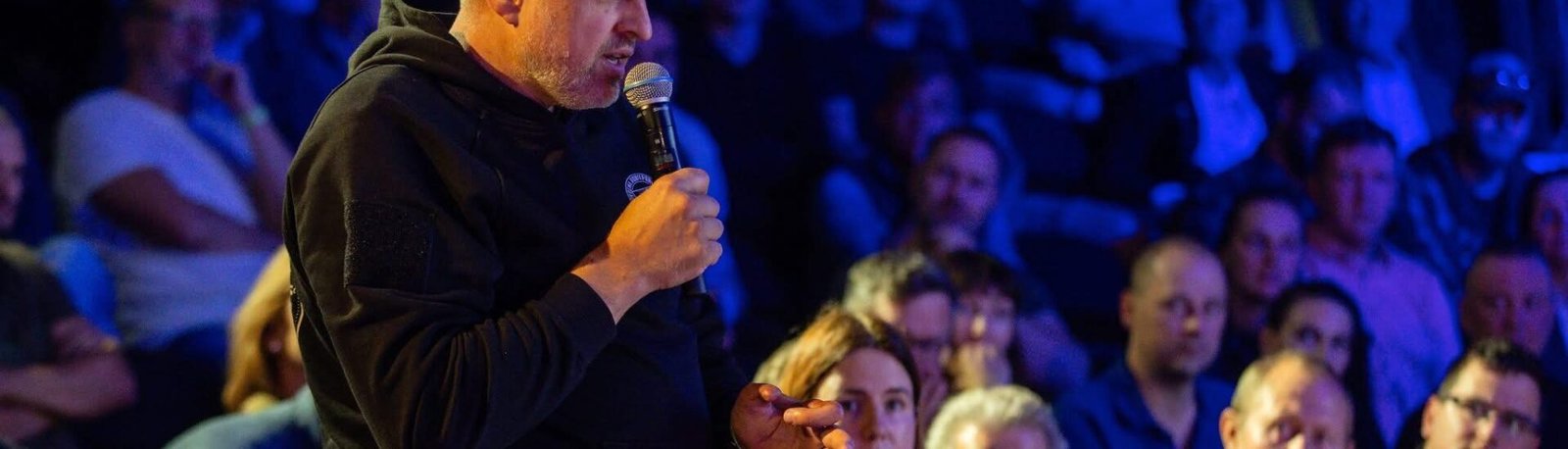
Recent events in Eastern Europe have opened a new chapter in history—one that is painful but also full of civic hope. Russia’s full-scale war against Ukraine not only shocked the international community but also awakened public consciousness in Lithuania. A striking example is Valdas Bartkevičius, a Lithuanian volunteer who, without fear of danger, constantly travels to war-torn Ukraine, delivering aid and providing vital assistance.
In this interview, we talk about personal calling, historical memory, civic responsibility, and today’s struggles, which remind us of our own difficult path to freedom. Valdas Bartkevičius’s work is not only a humanitarian act but also a continuation of history—a testament that the fight for freedom is never just a thing of the past.
Valdas, we’re speaking right after your latest trip to Ukraine. Where were you this time? What were you doing?
We were taking vehicles to the soldiers.
As always?
Yes, as always.
Why do you do all of this?
I’d rather not share specific examples, but I’ve seen how volunteers who started going to Ukraine from the very beginning can’t stop. Their numbers are growing—the circle is expanding. The people who see what I’ve had to witness many times are often left shaken. As for myself, you could say I’ve gotten used to these scenes—though, in reality, I don’t know if you can ever truly get used to them. Bombs, missile explosions, flying Shaheds… I don’t react anymore. Even artillery shots, if they’re a few kilometers away, don’t scare me.
Meanwhile, others who experience this for the first time just want to cry. It’s an indescribable emotional burden, a shock. And that’s when you realize that this “illness,” this empathy, is incurable. You can’t turn it off. It has to win; it has to help the Ukrainians finish what’s happening. There is no other way.
There might not even be a logical explanation for it. It all comes down to compassion—seeing people living in terrible conditions yet still willing to sacrifice their lives. Not for money, not for any personal gain. They are defending their homes, which, if you measure them materially, are much more modest than ours. But their value isn’t in money.
You say the number of volunteers is growing, but we often hear in the public sphere that people are getting tired of volunteering and helping. Are you disproving those theories?
I always say: you can’t get tired of volunteering. This might sound a bit paradoxical, but for me, volunteering is a kind of drug. Not in the sense of physical pleasure or ego, but rather as a spiritual force that motivates you to keep going. It’s an experience a person can’t get anywhere else.
Many of the people I travel with are deeply faithful. Among them are members of the Riflemen’s Union, reserve soldiers—people who understand that change starts with oneself. And the number of such people is growing. They don’t look at what someone else will give; they simply do what they feel is necessary.
Thinking about fatigue—if you remember the 1990s, volunteering in Lithuania was almost non-existent. But now, after 35 years of independence, we see how it has grown and flourished like a tree, sending branches into various fields: from Caritas or the Red Cross to organizations that help animals, the elderly, or vulnerable people. There are a lot of volunteers in Lithuania. So to say that volunteers are “tired” is simply impossible.
Yes, there might be a lack of financial resources needed for larger projects. But volunteering is first and foremost about creativity. A volunteer has to create value, a product that will convince even those who don’t yet believe. We live in a capitalist society, so it’s natural that even the best initiative has to speak to people in a language they understand. But a true volunteer can unite heart, idea, and action—and that is what inspires others to join.
So, it requires good marketing?
It can be marketing, but I call it the social services market, which is non-profit. And if you don’t grow it, it won’t grow on its own.
Yes, there are opinions that the amount of aid is decreasing and we can’t do anything about it. But from my own example, I can say that the amount of aid has only increased over the past year and this year. You could say that this year, we’ve raised more funds and collected more vehicles than in the same period last year.
I agree that volunteering is growing, in scale and numbers, but you know, sometimes it seems like it’s just a trend. Do you think that when day X comes, everyone will just run, even though they currently claim to be great patriots who would fight for freedom and so on?
They’d run. The majority would get scared. We have to look at what we’ve already seen historically. In Ukraine itself, some of the wealthy people ran, but some also stayed. It was the same in Lithuania… But homes are usually defended by the poor. These are the ones who have very little but value it as the greatest gift—that tiny house, that simple car—what they’ve earned throughout their entire lives. For example, in Ukraine, people in impoverished regions stood shoulder to shoulder to defend their homes. And not because they’re very valuable, but because they’re their homes.
They moved to Pokrovsk, which is being bombed, and other nearby villages. But people aren’t retreating to Lithuania or Latvia. They’ve moved just 30 km from their homes and continue to live and work near the front.
Some move to Kyiv, but if you notice, no one is going abroad anymore. Refugees are no longer coming here. They’ve already adapted; they understand how everything works. Bombs don’t fall on every house every night. There are certain patterns that show you have a higher chance of dying in a car accident than, say, in Lviv or Ternopil, where there have been almost no bombs because they’re too far away and are usually shot down on the way.
People don’t want to move far from home. Their real home is not Ukraine in general but a specific city, like Kramatorsk or Dobropillya. Like for us, Trakai or Lentvaris are our homes, and we are attached to them. Those who were born here can’t imagine any other home. This is our home, and we have to defend it. Whether those who came here to live from somewhere else would defend it—that’s a different question. Do they feel a sense of identity with this environment?
History shows that even politically inactive people, when necessary, stand up and fight. The ones we don’t see in public, whom we might even be inclined to write off as unpatriotic—they might be the very ones who, if needed, would take up a weapon and defend their homeland.
When we were arranging this interview, you were away and just returned from Ukraine. How often do you go there?
Volunteers usually go every two weeks, if there’s something to transport. Many people donate or buy things that need to be delivered urgently. The volunteers themselves go every week or every three weeks—it depends on the situation. Personally, I go every two months—family, children, all of that requires balance. Over two months, I spend about two weeks in Ukraine.
When I’m in Lithuania, I collect cars, talk to politicians, and participate in meetings. The experience of Ukraine is conveyed not through Facebook posts but through direct conversations with high-level people. These conversations aren’t made public—often there’s no point, or it would be unethical. Politicians need to consider the interests of their voters or party, so I don’t want to compromise them or put them in an awkward situation.
What I do requires a lot of time and effort—I have to run around, look for opportunities, organize, publicize. It’s an activist’s life, which, I hope, converts into real changes.
Your posts on Facebook are quite sharp, and I have no doubt that you have a lot of opponents because of them. You’ve also been a victim of your activities and your Facebook posts…
Yes, they attract opponents. But it comes from life experience. I grew up in Lentvaris—the environment wasn’t easy, and in the first years of independence, it was especially difficult here. Industry collapsed, many people lost their jobs. Life in such conditions hardened me. So it’s natural that there’s less softness in us; we were taught to act decisively.
The question is whether we can afford to “wrap words in pretty paper.” In my opinion, we cannot. Politicians do it because they represent various groups in society. But we, as activists, often take a stricter stance. And this is not just my view—there are more people like me. A stricter or even more radical stance is sometimes necessary to get things moving. If we did everything only within our comfort zone, we wouldn’t be where we are now.
Those who move the country forward “through suffering to the heavens” often have to be more determined. Yes, a strict position later softens and levels out with other opinions, but that’s the only way to reach a consensus.
For example, the discussion about reforming the russian school: my position is to close it immediately, while others say not to touch it at all. Finally, we find a compromise—to do it gradually. And that’s normal. If we had only talked about “gradual reform,” nothing would have changed.
Therefore, there must always be maximalists and minimalists—only then can the middle ground be found that satisfies everyone.
But that sharp, angry rhetoric of yours isn’t because you’re a very angry person?
No, no, God forbid. I’m a more optimistic and cheerful person. It’s just an image, a mask, if you will… When you don’t have much time for longer discussions, then maybe you seem angry, unhappy with life, or something else. But I just get tired of answering messages. I don’t even react to any threats or anything else anymore—people can say whatever they want about me, I’m completely uninterested, because working in this environment, it’s understandable that everything happens.
Haven’t you ever wanted to just quit all of this? You have a family, kids. I understand if you were alone, but now…
Well, then the question is, who will do it? If, in Ukraine, everyone said, “My family won’t let me fight,” others said, “My family won’t let me be a firefighter because it’s dangerous,” “My family won’t let me be a doctor because night shifts are exhausting,” “My family won’t let me drive a truck because it’s difficult to get back to life after two months on the road”… Then we would have no country at all, because if we base everything on a direct benefit to the family… Well, yes, family is the main interest, but we have to think more broadly. We have to protect that family.
So your family has come to terms with it?
No.
Do they still try to talk you out of it?
There are certain nuances that not everyone likes—not only in my family but in many others. The question often arises: why do you do so much for others and not for yourself? This is probably one of the most important things that people find hard to accept. Many believe that there must be personal gain in everything, that it’s only worth acting when personal needs are met.
But I believe that humanity has moved beyond that. Our daily life shouldn’t be limited to just satisfying our own needs—although that is, of course, important and necessary. Nevertheless, we have to move forward, to live for ideas that lead us forward. Such ideas are the foundation of our future—they are the engine that moves us forward as a nation, as a state, as a community. And those visions are worth fighting for.
So, life in a country improves when people start looking around, not just at what’s happening in their own backyard?
Yes. That is precisely a result of a good life, when people start caring not only about themselves but about others. That is what moves us forward as a community, as a whole society. If we don’t lock ourselves in our bubble and want to improve, then we become stronger. And our strength is not very welcome to our neighbors. Because when they see that we are getting stronger, we are moving away from them. Of course, their task is to bring us back to where we were—where there is distrust, hatred, anger, aggression, hunger, cold, and more—actions that prevent people from improving their lives and coming together in groups. Therefore, we, as active, civic-minded citizens, must unite and create an even larger community, an even greater good.
Does your organization work alone, or do you collaborate with other organizations providing aid to Ukraine?
We work together with other organizations. Most of them are in Kaunas: we load cargo here and send humanitarian aid to various institutions—hospitals, soldiers, and for other needs. From candles and nets to bedding—everything is needed. For example, for wounded soldiers, bedding that is not in very good condition is used, meaning it’s only needed for one use, as there’s a lot of blood and it’s difficult to wash.
Washing machines are also very much needed. In Ukraine, for example, washing machines were often a rarity because the infrastructure there had not reached the same level as ours. A washing machine was a luxury, but now it has become an everyday item, especially in cities. Of course, no one gives away a good washing machine because they are very expensive for their standard of living. What seems basic to us is in short supply there.
A country fighting the challenges of war cannot allocate as much money as everyone needs. It’s a constant struggle with a lack of resources, but this very limitation encourages the creation of new technologies that are used not only in war but also in the energy and infrastructure sectors.
When infrastructure is constantly being destroyed, it needs to be rebuilt quickly. Therefore, the lack of money forces people to find solutions and this encourages creativity.
That’s why we work, doing what we can. In Kaunas, there are at least five or six organizations we work with very closely. We also have relationships with smaller funds and organizations.
Is there no competition between organizations?
There always has to be competition. In my opinion, competition is a welcome thing. In this area, it’s a little different, but everyone wants to do more. Not to earn money, but to do more—the main goal isn’t profit, but help and achieving better results, because then you become the best volunteer.
A motivating environment and competition are important. Even in social services like helping Ukraine, competition must exist.
Valdas, let’s talk about the war itself and how people can live under its conditions. Many of us living in Lithuania imagine that all of Ukraine is a war zone and you can’t go there at all, because you might be shot immediately. But people still live a “normal” life there somehow…
Those narratives… It’s strange to me because at the beginning of the war, the mainstream media, it seems, still didn’t understand what was happening. But western Ukraine, as I mentioned, has training bases. Sometimes air raid sirens sound, there are missile attacks, infrastructure is destroyed, but still—the situation is not as dangerous as it might seem. You can live normally there. And people really do live. They get used to the constant wailing of sirens, which happens quite often.
Moving closer to the east or north, the frequency of sirens and the number of strikes increase. Cities like Dnipro or Kryvyi Rih become more dangerous. In Kryvyi Rih, there isn’t a single functioning hotel right now—they’ve all been destroyed. There are cities close to the front where the danger is indeed greater—they are only 100-200 km from the front line. However, Kyiv, in comparison, remains quite safe. Life there has almost returned to its normal rhythm—as it was before the invasion. The population in Kyiv has even increased, as many people have moved from the eastern regions and settled in the capital. The city is full of people. Although there is sometimes a curfew, the city is alive. Kyiv—like other major cities in the world—has about five million residents, including the suburbs. Everything works there, even during the war.
People simply can’t live in fear constantly—they get used to it. Experience shows that even if missiles hit, they don’t always strike residential buildings, and the air defense system works.
Speaking of the Lviv region or the Carpathian Mountains—it’s very safe there. There are no air raid alerts in the Carpathians, no curfews. These areas are used for the rehabilitation of soldiers. The Carpathians are about 1500 km from the front—that’s a long distance. Furthermore, the mountainous terrain provides even greater safety.
Soldiers returning from the front also want to rest. They want a vacation, to use services, to escape from the war. It’s completely human. Soldiers can’t constantly be in trenches, in the cold, or constantly endure hardship. They have a right to rest. If there is a demand for rest, there must also be a supply.
Sometimes it might seem that Kyiv is living too well, but people who return from the front no longer want war. They want a normal life. They want normal food, restaurants, hair salons, shopping centers—they just want a simple daily life, because a person cannot live in a war for four or five years. Some of my friends have been in it for eleven years. The soldiers say, “We really like that this is possible.” They don’t have to go abroad. Most of them don’t even want to go, even though they could. But they feel a responsibility—their brothers and sisters are still on the front lines.
However, this is where the russian propaganda machine kicks in again—trying to diminish the entire country. Although in russia itself, everything is happening the same way. They also have restaurants and hotels being built. So why can one do this and the other can’t? It all depends on how the information is presented—what propaganda is at work.
Valdas, you’ve been a volunteer since the beginning of the war?
Yes. Since the beginning of 2022.
In your opinion, how has the situation changed over these three years—has it gotten better, worse, or remained more or less stable?
There was more uncertainty in 2023, and there still is now. But today, it’s clear that under these conditions, Ukraine has not broken and can fight for a very long time, because the war has become a little cheaper. If, say, in 2022, everyone was saying that soldiers needed a good car that wouldn’t break down, one that would cost 10, 15, 20 thousand euros, that it had to be very good, then today a car for 2, 3, 4, 5 thousand euros is needed, one that might only last a week, and everyone understands that there’s no need to invest money in it anymore. So now, the attitude has changed dramatically.
People’s attitudes have changed. Of course, in 2022, people in Ukraine were more united, more empathetic, more attentive to soldiers. Now everyone has gotten used to it; it has become a daily routine, and it’s rare for someone to give up their place in line for a soldier, or for a military vehicle to be given priority in a traffic jam, or for someone on the street to say “thank you” to those delivering aid to soldiers. Still, the fatigue and this life, which has turned into a routine, affect these things and people’s moods.
But can you get tired of war? Well, yes, you probably get tired of war, but it’s not something that would stop you and make you say, “Well, that’s it, I’m done, I’m turning off the lights.” War is not about turning off the lights. There are more actions there, and it wasn’t us, not the Ukrainians, who started this war, no matter what the propaganda says. Propaganda wants to justify the war and blame those it is attacking. Well, it’s always easiest to blame the weak.
Why do so many people still choose to fight? They simply have no other choice. They are defending their homes, their families, their homeland. War is not a choice; it simply becomes a necessity.
The process of fighting for freedom is complicated because it forces people to give up their life norms, their daily routine, and instead take up a fight for survival. It’s a mixture of sacrifice and heroism.
The cost of war is immense. Every step, every choice requires a sacrifice. But if there is no choice, the fight for survival becomes necessary.
In your opinion, is the Ukrainian government handling the war well?
Publicly, we are not inclined to criticize their government, but, to be honest, both at the beginning of the war and now—especially after the change in US president—you can see that the Ukrainian government is indeed able to act effectively. They have managed the situation. The economy has not collapsed. Yes, there are nuances, but at the same time, while fighting a brutal war, they are able to fight corruption—it’s unbelievable. Of course, this is later used in russian propaganda: “Look, Ukraine is corrupt.” But the very fact that they show efforts to fight corruption means that it’s happening. And they’re not afraid to show it. But it’s like that “rake”—you step on it and get hit in the forehead. There is a risk that it will turn against them.
At the state level, yes—it could be better. But everything can always be better. The question is, is it possible under wartime conditions? I doubt it. For the government to act effectively, a competitive environment is needed, and there just isn’t one now. Elections are impossible now. Although some, who have not been to Ukraine, say that “maybe it’s possible.” No—it’s impossible. And not just according to the law, but physically. There are a million soldiers on the front lines. How could they vote? They can’t vote at all. There is no electronic voting; it is impossible to organize campaigning. How can you campaign on the front? There are many things that are simply impossible right now. To hold an election now, you would have to essentially exclude several million refugees, a million soldiers, people who have moved, who don’t have registration, or who live somewhere else temporarily. It would require enormous resources and finances to sort all that out. And now there are whispers about upcoming elections—these are often messages spread by russian propaganda. In russia, there haven’t been free elections for about 30 years. It is very convenient for them to show that there is no democracy in other countries either. But it wasn’t Ukraine that attacked russia—russia attacked Ukraine.
So, that’s why there are no elections in Ukraine right now. If there were, it’s likely that President Zelensky would still win. Although his ratings had fallen at one point, he is currently strongly supported again. Basically, there aren’t many serious complaints against him.
The only question is whether he would want to run for president again…
That’s the question, because the fatigue on his face probably says a lot. His life has changed 360 degrees, and his life is difficult, both in terms of security and those daily trips around the country by car, not by plane or helicopter—it’s difficult work.
Returning to our country’s affairs, most people, probably not just Lithuanians but residents of other Baltic countries, fear an invasion of our countries. Do you believe that the russians could attack Lithuania and other countries?
Not could, but will. While the situation with America is still unclear—what its contribution will be, whether it will come to our defense or not, and so on—there are many nuances that could be serious factors in them taking that step and testing, for example, NATO’s unity. Life shows that plans are plans, and reality is reality.
We must do not only what the military says but also prepare ourselves, which means not just waiting for our partners to do it for us, but we must start with ourselves: participate in voluntary national defense structures, the Riflemen’s Union, etc. We understand that not everyone who joins can go into battle, but it’s still better than doing nothing. Today, the war has also changed a lot—it’s no longer running through the forest with a rifle. War is now technology—drones. Practically a large part of the war takes place on screens. And in this war, there is a place for those people who, well, can’t run fast or don’t have the strength to carry heavy ammunition—it has activated a much wider part of society than before.
Valdas, you often travel to Ukraine, you see its reality better, you communicate more with various people and officials, politicians, so maybe you understand better—is an end to the war possible? If so, when could it be?
I would like to say, as my friend the musician Ivan Lenyo from the band Kozaks System says, that the war will probably never end. The war can end if we defeat russia. But when will we defeat it, that’s the question. Probably never. And if we hope that they will stop and not go on, we are mistaken. They will go. Their history shows that they are an empire, and empires can only exist by expanding. And that is their goal. They say this very clearly, openly. By the way, I would like to point out that the russians are truly sincere in telling the truth. For example, when talking about their goals, they always tell the truth. They say, “We will attack you.” But our politicians say that “they’ve probably made that up.” “It can’t be.” We imagine that they don’t want to, can’t, or don’t have the capacity. We decide for them whether they can or can’t. That’s not the answer. The answer is, do they want to do it? And if they want to do it, they will. If their economy allows them to do it, if they can continue to sell oil and invest the money in weapons rather than roads, and it benefits them, then they can do it. And are we ready to receive them? That’s another question. Will our partners help us? That’s another question.
You have to understand that Ukraine is one of the world’s, so to speak, bastions in modern Europe, which can also defend us, just as we, the Grand Duchy of Lithuania, once defended Europe from the incursions of the Mongols and Tatars*. We are standing where we once were again. Therefore, it is very important to help Ukraine stand where they are now and not allow the russians to break through.
Well, one day it could happen that russia could fall apart, as has happened with other empires. Empires that stop, that don’t expand, they fall apart.
Spoken with Rasa JAKUBAUSKIENĖ
*Editor’s Note: The speaker is here referring to historical Mongol and Tatar military campaigns of the Middle Ages, not the contemporary indigenous Crimean Tatar people, who are a crucial part of Ukraine’s identity and resistance against russian aggression.